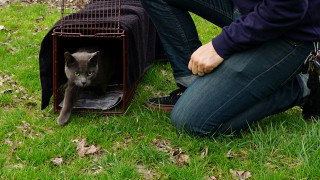
Trap-Neuter-Return (TNR) saves lives
Trap-Neuter-Return (TNR) is the only humane and effective approach to community cats, or unowned cats who live outdoors.
Scientific studies show that TNR effectively addresses the community cat population by ending the breeding cycle, meaning no new kittens are born to a community cat colony. As sound public policy, TNR addresses community concerns, reduces shelter intake and killing, and reduces calls to animal services, all of which save cats’ lives and taxpayer dollars.
When cats are free from the burdens of mating and reproducing, their relationships improve with the people who live near them (think: no more kittens outdoors or yowling, roaming, fighting, or spraying). Additionally, many diseases associated with reproduction, like certain cancers, are prevented.
Alley Cat Allies formed in 1990 to bring TNR, which was already successful in the UK, to the United States. Our goal was to upend the relentless, ineffective, and pointless cycle of catching and killing cats in animal shelters that had been standard procedure for decades. We launched a national movement with our educational materials, regional workshops, mobilization of advocates, and re-writing of laws. As a result of this hard work, TNR has become mainstream and a benchmark of humane care for animals.
Thousands of communities across the U.S. and around the world have embraced TNR at the grassroots level or as official government policy. In rural and urban settings, cold and warm climates, and everywhere in between, TNR works for cats and communities.
- Why Trap-Neuter-Return: The Case for TNR
- Trap-Neuter-Return Effectively Stabilizes and Reduces Community Cat Populations
- Key Scientific Studies on Trap-Neuter-Return
What is Trap-Neuter-Return?
The TNR process is simple: community cats are humanely trapped, brought to a veterinary clinic to be spayed or neutered, vaccinated, and eartipped (the universal sign that a cat has been spayed or neutered through a TNR program), then returned to the outdoor homes to which they are bonded so they can live out their lives where they thrive.
It is also best practice to MICROCHIP community cats during the TNR process and register the microchip with the information of the cats’ caregiver or the group that carried out TNR. Then, should a cat be picked up by animal control or impounded in a shelter and scanned for a microchip, the relevant people can be informed that the cat is at home outdoors, is spayed or neutered, and should be returned immediately.
- Spay and Neuter: Good for Cats, Good for Communities
- Community Cat Health Analysis: Living Healthy Lives Outdoors
- Community Cats and the Public: A Healthy Relationship
Bring Trap-Neuter-Return to Your Community
Alley Cat Allies can show you the way. We were the first U.S. organization to create guidelines for TNR, including a step-by-step, how-to process for TNR programs geared toward caregivers, volunteers, veterinarians, and advocates. We can help you advocate for TNR policies and ordinances that will save cats’ lives.
- How to Conduct Trap-Neuter-Return
- Trap-Neuter-Return Ordinances
- How to Implement an Organizational Trap-Neuter-Return Program
- Resources for Shelters
Before TNR
For more than a century, the American shelter and animal control system has been relying on catching and killing outdoor cats to control their population. This approach continues to fail, and the number of outdoor cats increases despite the millions of vibrant, healthy outdoor cats who are killed each year. Taxpayer money that funds shelters and animal control agencies is wasted on an endless cycle of trapping and killing. Increasingly, the public agrees that the money spent on killing could and should be re-allocated to programs that help animals.
With catch and kill policies, cats are removed from an area in the hopes that the population will never bounce back. But removing cats only creates a vacuum in the environment, where new cats move in to take advantage of available resources. The new cats quickly breed and the cat population rebounds, or even grows. Catch and kill policies are not only cruel and ineffective, they are the antithesis of the compassionate values of the public, which overwhelmingly supports humane, effective policies and programs for cats.
After TNR
Through TNR, adult cats, who have been spayed or neutered, vaccinated, and eartipped, are returned to their outdoor homes to live out their lives with their feline families. Many of these cats have dedicated caregivers, who provide food and outdoor shelter with their own time and money.
TNR balances the needs and concerns of community cats and the people among whom they live. The fact is people don’t want cats rounded up and killed. When citizens bring a cat to an animal shelter, they do so believing the cat will be safe and cared for, not terrified in a cage for days only to be killed. What the people want are cat populations stabilized through humane methods that bring cat mating behaviors in check so all can live in harmony.
TNR in conjunction with community cat care best practices is the recipe for happier communities in which cats and people peacefully co-exist. Cats Are Community™, and TNR is the best way to help our feline community members!
Trap-Neuter-Return Case Studies:
- Alley Cat Allies Establishes Trap-Neuter-Return Program on Atlantic City’s Boardwalk; Boardwalk Cats Project is Born
- Alley Cat Allies Leads Coalition to Support Trap-Neuter-Return in Baltimore
- Alley Cat Allies Helps Washington, D.C. Establish Humane Cat Programs
What’s Next for TNR?
TNR is about more than saving today’s cats: it is the future of animal control and sheltering. Every year, more and more shelters are adopting TNR (or Shelter-Neuter-Return) programs to save more cats and improve their communities. Join Alley Cat Allies and help us spread the word. You can bring TNR to your community too!
- Advocate for Humane Policies for Cats in your Community
- Trap-Neuter-Return Ordinances and Policies in the United States: The Future of Animal Control
See Trap-Neuter-Return in Action:
Founded in 1990, Alley Cat Allies is the leading advocacy organization for cats with a mission to transform and develop communities to protect and improve the lives of all cats and kittens. Together with our over 1.8 million supporters, we work toward a world where cats are valued and every community has humane and effective programs and policies to defend them.
Through our fearless advocacy, humane care, education and outreach, and law and policy activism, we equip and mobilize citizens, advocates, grassroots groups, shelters, veterinary professionals, and elected officials across the United States and around the world to improve their communities for cats through nonlethal, evidence-based approaches.
Our website is www.alleycat.org, and we are active on Facebook, X (Twitter), Instagram, LinkedIn and YouTube. Charlene Pedrolie is the President and Chief Operating Officer of Alley Cat Allies.