
An Update on Ash’s Law
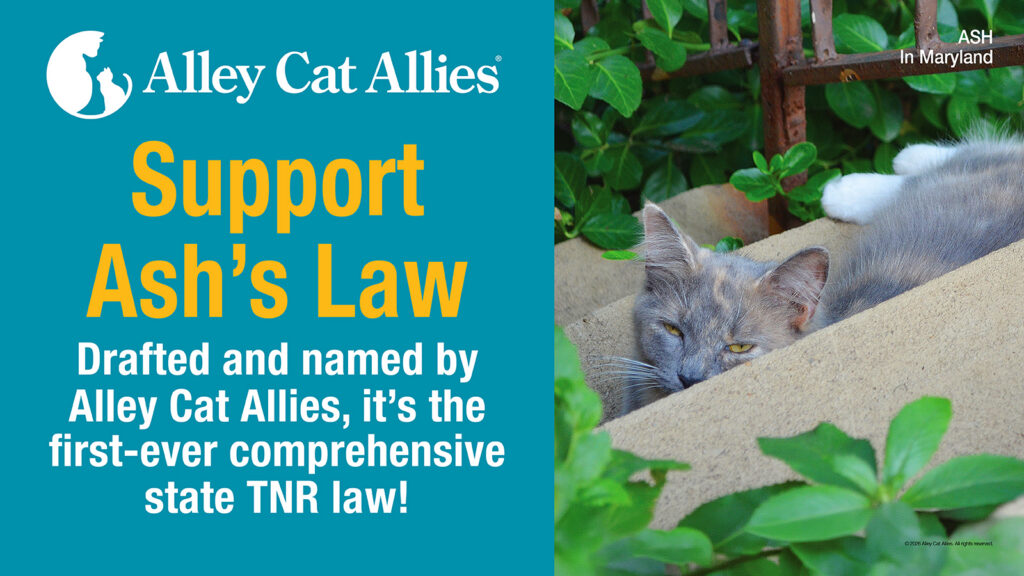
The first-ever comprehensive statewide law protecting Trap-Neuter-Return (TNR) and community cats, drafted and named by Alley Cat Allies, is now up for consideration in the Maryland Senate!
If you live in Maryland, please take urgent action in support of Ash’s Law in the Senate:
If you already asked the Maryland House of Delegates to vote YES, thank you! This is the next step in the process—the Maryland Senate Education, Energy, and the Environment Committee will hear Ash’s Law as SB 750 on Tuesday, March 10.
How Ash’s Law Protects TNR and Community Cats
If passed, Ash’s Law would officially establish and protect TNR as the law of the land in Maryland. Ash’s Law is unique in that it goes a step further than any other law, preventing local jurisdictions from prohibiting or restricting the TNR efforts of organizations and residents.
And to further protect community cat caregivers, Ash’s Law amends state criminal law to clarify that returning a cat to her outdoor home through a TNR program is not abandonment. It is, in fact, a reunion.
If you don’t live in Maryland, please share the action above with those you know who do. Let’s do this in honor and memory of Ash and for all community cats!
Learn more about Ash’s Law and Ash’s story.
Making History with Ash’s Law
On February 25, we made history with the very first hearing of Ash’s Law! Alley Cat Allies testified in person before the Maryland House Environment & Transportation Committee on the lifesaving benefit of this groundbreaking bill:
When You Take Action on Ash’s Law, You Send the Following Letter
As a resident of Maryland, I am writing to urge you to protect community cats and those who care for them by saying “yes” to SB 750 and HB 912, or Ash’s Law, a statewide law supporting Trap-Neuter-Return (TNR).
Through TNR, the only humane and effective approach to community cats, community cats are humanely trapped; brought to a veterinary clinic to be spayed or neutered, eartipped (the universal sign that a cat has been spayed or neutered through a TNR program), and vaccinated; and then returned to their original outdoor homes.
TNR is proven to stabilize community cat populations by stopping the cycle of reproduction; improve the cats’ health through vaccinations; and benefit animal control agencies and shelters by reducing cat intake and calls of concern.
Today, communities in Maryland and across the country have adopted ordinances or policies supporting TNR, and thousands more worldwide are conducting grassroots, volunteer-led programs. It is critical that we have a measure, Ash’s Law, in place to permit TNR programs and protect community cats. SB 750 and HB 912 make TNR the law of the land and creates consistency across the state.
Ash’s Law also protects the compassionate people who care for community cats. Maryland residents who spend their own time and money to conduct TNR will gain critical protections, including the clarification that returning a cat to her outdoor home through a TNR program is not criminal abandonment. It is, in fact, a reunion.
I stand for humane, effective, and compassionate approaches to community cats. And so, I ask you to support SB 750 and HB 912, for the sake of the cats and all of your community members. Thank you for your consideration.